
Workshop on Artificial Intelligence and real-life exercises for schools

Continuing from the previous entry, in this one I wanted to contribute my small grain of sand to the odyssey that is implementing artificial intelligence exercises and acquiring digital competencies in some educational institutions and schools.
A few years ago, in 2019, a research colleague and I proposed a simple workshop to teach and demystify fundamental ideas about artificial intelligence (AI). The workshop lasted a maximum of 1 hour and 30 minutes, covering the essential content to understand what artificial intelligence is, along with some basic mathematical algorithms. In the trial runs we conducted in high schools, it was a resounding success. We even got to publish the workshop in a prestigious scientific journal. In other words, other researchers have certified that the workshop is effective and well-structured. And you know what's best? The workshop is based on block-based programming language Scratch, and everything is completely open source and free. You can find the workshop in my GitHub repository.
The procedure of this small workshop consists of the following activities: In the first 15 minutes of the session, students were provided with the following concepts in a very concise manner:
Introduction to artificial intelligence
What the K-means clustering algorithm involves
How a neural network works
Subsequently, the students had 45 minutes to complete two exercises and put into practice the basic notions that had been presented to them a few minutes earlier. The methodology for this practical part was implemented as follows: the students worked in pairs and were provided with a file containing an artificial intelligence algorithm implemented in Scratch. This file already contained almost all the necessary code, except for a couple of gaps that they needed to fill in to ensure the entire program executed correctly. To make it a bit easier, in one corner of the Scratch workspace, students had the code pieces that needed to be fitted into the gaps, but they were disordered. Once they completed the code, the students could verify whether or not they had succeeded by running it in Scratch.
The students were given two problems:
The K-means clustering algorithm, where they had to classify a point cloud into as many clusters as they wanted. The clusters were defined by 'fat' colored points, and the classification involved coloring the smaller points according to the color of the nearest 'fat' point.
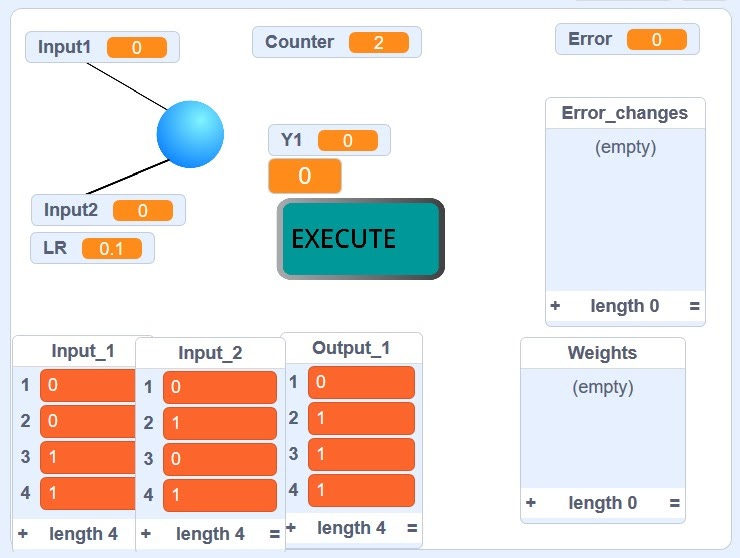
Subsequently, a very simple neural network (two inputs and one output) was assigned, trained with the input and output data of an AND logic gate. They had a maximum of 20 minutes for each exercise.
Below, I include a representative image of these problems:
In 2020, COVID-19, which is well known to all, forced us to stay at home. It compelled educators worldwide to rethink their curricula in an online and digital format. This accelerated the European Commission's digital education strategy, known as the Digital Education Action Plan. As I shared in the blog, I participated from 2021 to 2022 in the European Commission's Expert Group on Artificial Intelligence in Data and Education. There were about 15 experts in the group, one representing each Eurozone country. So, humbly, I've gained some knowledge in these areas.
During the previous school year, over a dozen high schools across Spain contacted me for assistance in understanding and implementing the AI workshop I mentioned. The students' ages ranged from 14 to 18. After reaching out to them to see how it went, they were quite pleased with the material.
Thus, over the past year and the current one, our research group has continued to create more accessible, simple, and understandable exercises for both students and teachers, adaptable to various levels of difficulty in the classroom. Thanks to what I've learned from my European colleagues, we now have a much clearer understanding of what works and what doesn't. We now have exercises that adapt to each student's learning pace, allow for different numerical statements for each student, and measure the speed and level of learning for specific tasks. And, of course, all of this is available without the need for complex software or computer programs. It's all open source.
Teachers and schools are putting in an enormous effort to navigate through bureaucracy, accreditations, and competency-based evaluations mandated by government authorities. Embracing AI as a tool, without fearing a loss of the teacher's role, is the way forward. Let's make their lives easier and not resist this technology, which has already become an integral part of our lives.