
When Drones Fall
Engineering Lessons from Amazon Prime Air's Crash Record

Last February, residents near an apartment building in Richardson, Texas, filmed something unsettling: an Amazon delivery drone drifting toward the building’s facade, shedding propeller fragments mid-air before crashing onto the sidewalk below, smoking. Nobody was hurt. But what matters most is not this particular incident: it was not the first, second, or even third.
Since late 2024, the MK30, Amazon Prime Air’s most advanced delivery drone, has accumulated at least seven publicly documented significant incidents in just fourteen months of commercial operation. For anyone working in autonomous systems and UAVs, this pattern deserves careful technical reading, beyond the media impact of each viral video.
The failure pattern
The first major incident occurred on December 16, 2024, at Amazon’s test facility in Pendleton, Oregon. Two MK30 drones cut power to their motors mid-flight at 66 and 56 meters altitude respectively, and fell to the ground within minutes of each other. The identified cause was a LiDAR sensor failure: rain generated echoes that the system interpreted as a landing signal, triggering the motor shutdown protocol while still airborne. The bitter irony is that the previous model, the MK27, included a mechanical backup sensor (the so-called squat switch) that detected physical ground contact. Amazon had removed it from the MK30, presumably to reduce weight or cost. The consequence was a nationwide commercial pause in January 2025.
The design decision of eliminating hardware redundancy in a safety-critical system is precisely the kind of mistake aviation history has documented repeatedly. Redundancy is neither elegant nor cheap, but in systems where a failure means a 35–40 kg object falls on a populated area, its absence is difficult to justify.
The second most revealing episode occurred on October 1, 2025, in Tolleson, Arizona. Two MK30 drones struck the boom of a construction crane minutes apart, in consecutive flights. Both were destroyed. One person was treated for smoke inhalation. The most striking detail from an engineering standpoint is the sequence: if the first drone collided with a static, known obstacle, why did the second repeat the exact same error minutes later? This suggests there was no real-time update of the operational airspace between flights, or that the detect-and-avoid system did not process the information from the first incident. This is not a random accident: it is a systemic failure.
Six weeks later, in November 2025 in Waco, Texas, just thirteen days after Amazon launched service in that city, an ascending MK30 caught a propeller in an overhead internet cable, severed the wire, and executed an emergency landing. The FAA opened an investigation. This type of obstacle (cables, power lines, dense vegetation) represents precisely the unstructured environment that any autonomous navigation system in an urban area must be able to handle. They are predictable as a category, even if unpredictable in their exact position.
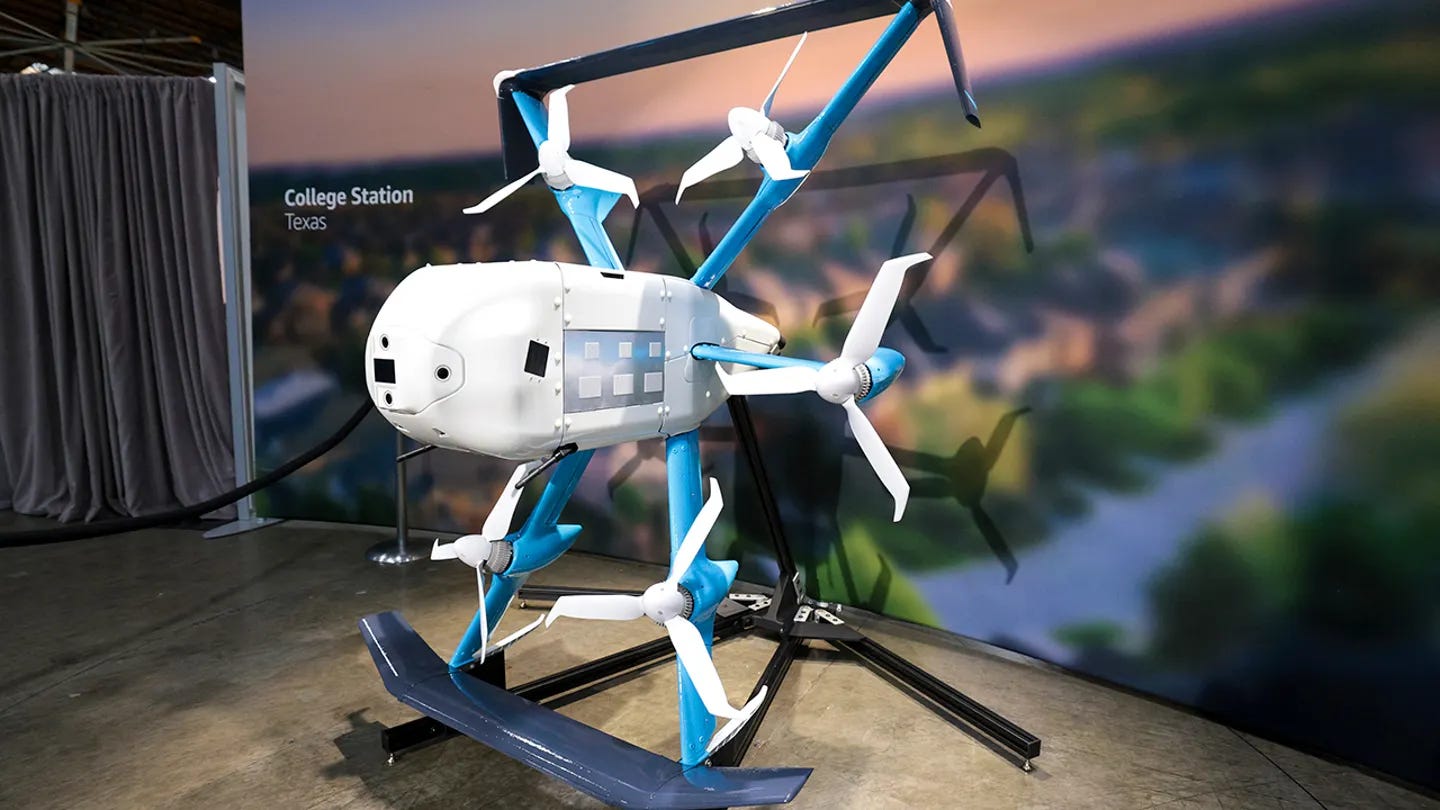
Between these three major incidents, others occurred: a precautionary landing at an apartment complex in Tolleson in May 2025, a package dropped into a swimming pool in Arizona in July, an emergency landing less than a meter and a half from a pedestrian in Goodyear in October, and finally the building collision in Richardson in February 2026.
The numbers that matter
David Ison, an advanced air mobility researcher, performed the calculation many avoid: with approximately 4,000 flight hours accumulated by Prime Air and at least 7 significant incidents, the resulting rate is roughly one incident per 570 flight hours. U.S. general aviation records one accident per 100,000 flight hours; commercial aviation, one per one to two million.
An important caveat: these are not comparable categories. Delivery drones operate at low altitudes, in complex urban environments, with technologies still maturing. Commercial aviation has spent a century refining its safety protocols. No one would expect equivalent rates at this stage. But the relevant argument is not the absolute comparison: it is the trend. These incidents are occurring at a very low volume of operations. If Amazon scales toward the 500 million annual deliveries it has declared as a target for 2030, even a substantial improvement in incident rate would imply very different absolute numbers.
The comparison that makes Amazon uncomfortable
Not all drone delivery operators share the same track record. Zipline, which primarily operates with a fixed-wing architecture along more controlled aerial corridors, has completed over two million commercial deliveries and flown more than 125 million autonomous miles with a notably different safety profile. Wing, an Alphabet subsidiary, has made over 450,000 deliveries with one well-documented incident: a power line collision in Brisbane in 2022. Walmart, through its partners Wing and Zipline, has surpassed 150,000 deliveries since 2021.
The difference is not just one of scale. Zipline, for instance, operates with a design philosophy in which system reliability is built on predefined routes, close integration with local airspace, and an architecture that minimizes the complexity of real-time autonomous decisions. Amazon, by contrast, aims for a more flexible and omnipresent operation, which imposes far greater demands on the autonomous navigation system. This ambition is legitimate, but it carries an engineering cost that the incidents are making visible.
What this says about the field
Beyond Amazon, these incidents raise relevant questions for the entire sector. Detection and avoidance of non-cooperative obstacles (cables, cranes, vegetation) remains one of the most technically difficult problems in low-altitude autonomous navigation. LiDAR sensors are extraordinarily useful under nominal conditions, but their robustness against environmental disturbances (rain, fog, dust) remains an active area of research. Combining LiDAR, vision, radar, and prior environmental data is the right direction, but adds integration complexity that can itself become a source of failures.
Redundancy, moreover, is not simply a matter of adding sensors. It is a design philosophy that asks: what happens when this component fails? And when two fail simultaneously? Removing the squat switch from the MK30 was not a minor engineering oversight: it was a signal that pressure to reduce cost or weight was competing with safety culture. In aviation, that competition has a well-known history.
The regulatory landscape adds another layer of complexity. The FAA is developing Part 108, which would significantly expand commercial drone operations. The AOPA has explicitly cited Amazon’s incidents as evidence that this regulatory expansion may be moving too fast. In Europe, EASA has its own regulatory framework (the Open, Specific, and Certified categories) which in principle imposes greater certification requirements for operations over populated areas. But commercial pressure to scale is global, and regulatory frameworks always lag somewhat behind technological reality.
Conclusion
The problem is not that Amazon is developing delivery drones. Last-mile logistics faces real challenges, and the technology has genuine potential to help address them. The problem is when deployment speed outpaces system maturity, and real urban environments with their variability, unmapped obstacles, and unpredictable weather become the de facto test bench.
Safety in autonomous systems is not a problem solved primarily with more data or more flights. It is built through conservative design decisions, deliberate redundancy, and an organizational culture that treats every incident as valuable information, not as a cost of doing business. For now, the MK30’s track record suggests Amazon is still learning that lesson.
We’ll see.
No parece muy probable que el modelo de Air Prime pueda implantarse en un país con un urbanismo como España, ¿no? Me cuesta ver la lógica económica de esto incluso en EE.UU, más allá de la supresión de la mano de obra, pero eso llegará igualmente con el coche autónomo, cuyos costes de desarrollo sí son amortizables a escala mundial.