
Grade inflation. Everybody's getting an A
Grades have been rising for decades in secondary schools and universities across the Western world. Students aren't getting smarter. The system is designed to make it look like they are.

There are two curves that should move together, and they’ve been going in opposite directions for years.
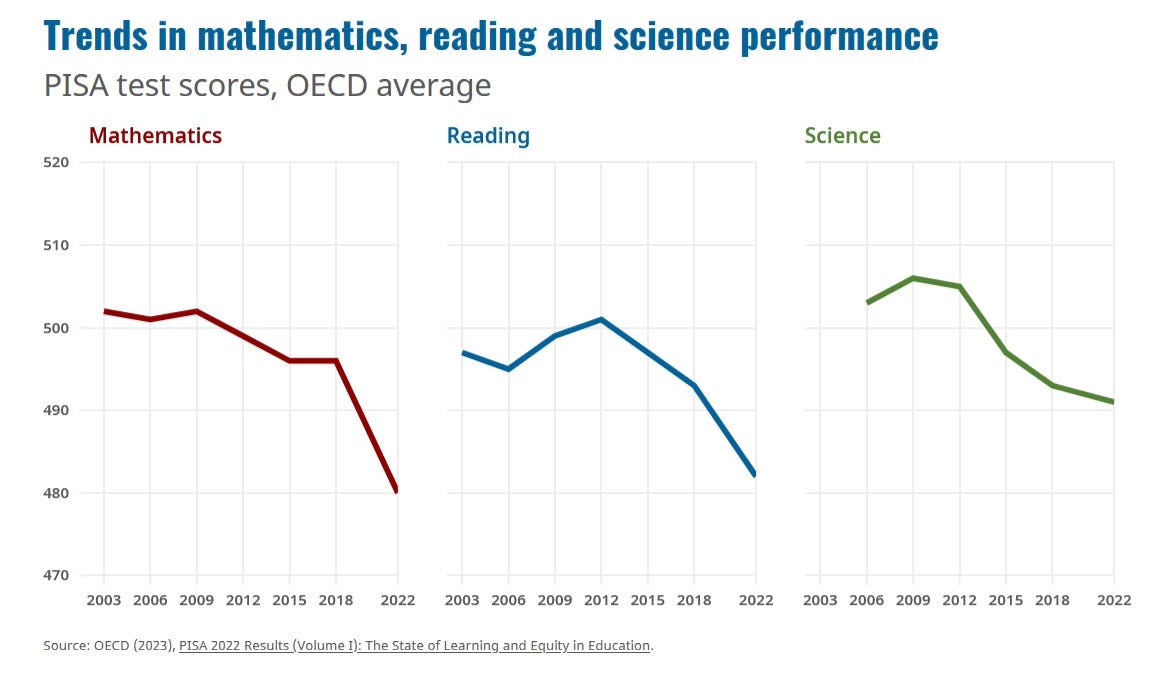
The first: the OECD’s PISA 2022 reports document a sustained decade-long decline in the performance of 15-year-olds in science, reading, and mathematics, affecting virtually every Western country.
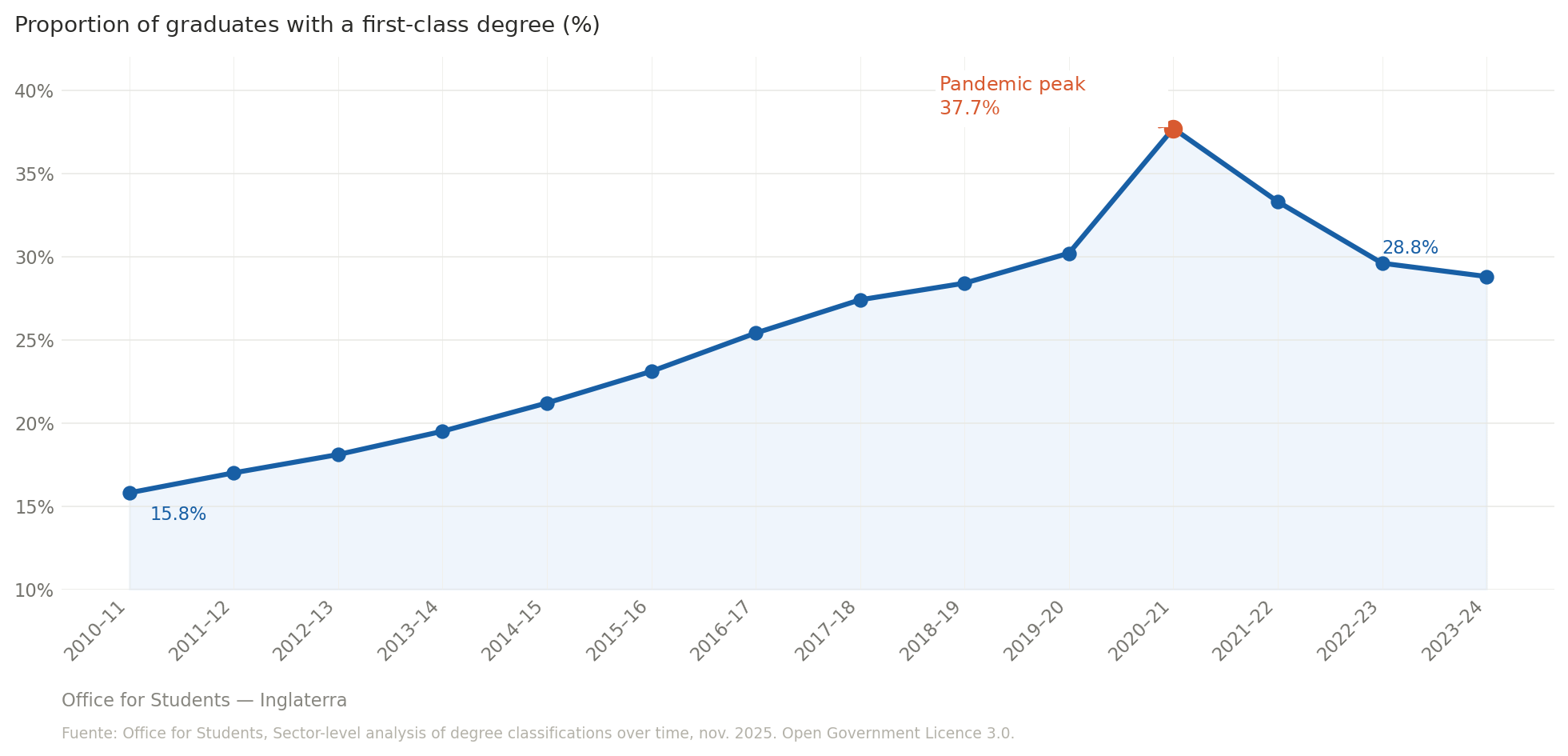
The second: in that same period, grades have not stopped rising. In the United Kingdom, the proportion of graduates receiving a first-class degree (the highest classification) went from 16% in 2010 to 35% in 2022. More than double in twelve years.
And even at the most prestigious Ivy League universities, at Yale the proportion of A grades rose from 67% in 2010 to 79% in 2023. At Harvard, 84% of all undergraduate grades are now an A or an A-.
Both curves are real, measured by different institutions with no coordination between them. Together, they raise an uncomfortable question: are students learning more, or are we measuring worse?
A global phenomenon, and not just in universities
The temptation is to read this as a problem with universities, or as an Anglo-Saxon problem. The data dismantles both readings.
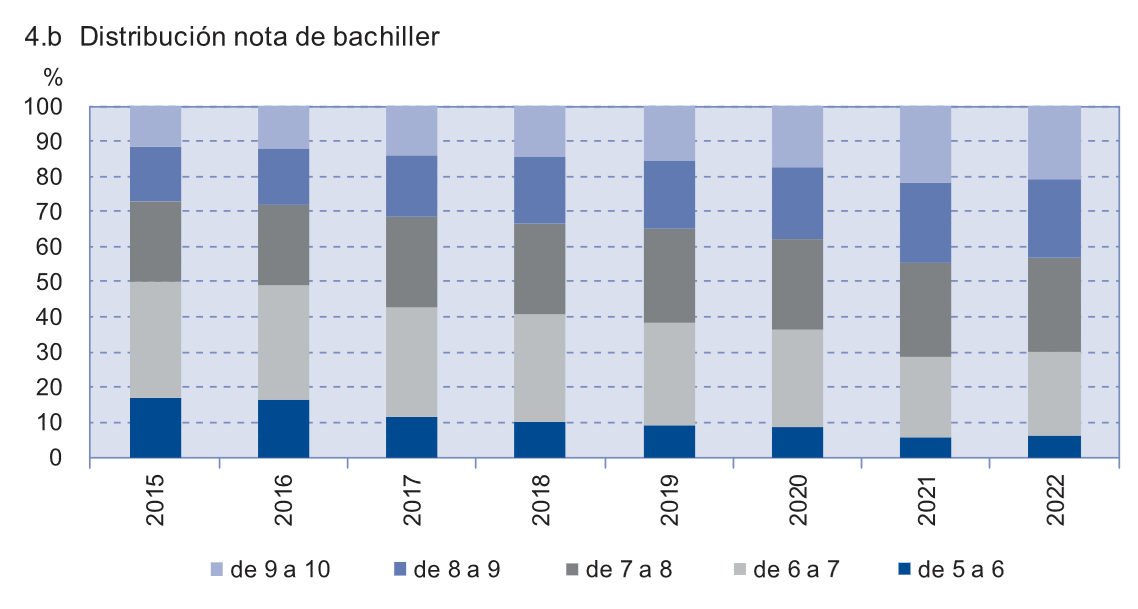
In Spain, 70% of passing grades in the final two years of secondary school (Bachillerato) are now top marks, a proportion that has risen twenty points in less than a decade.
The effect flows directly into the university entrance exam (EBAU, formerly Selectividad): in the most recent sitting, 96.84% of candidates passed, a historic record. The rectors of Spain’s university conference (CRUE) have acknowledged this publicly: the current model “is excessively flexible, resulting in an artificial inflation of grade cutoffs.”
What’s most revealing is that Spanish grade inflation didn’t wait for the pandemic. A report by EsadeEcPol documents that a 2017 reform which reduced optionality in the EBAU‘s elective phase produced an artificial increase in grades because the same subject ended up counting twice toward the final score. Earlier, in 2013, when the minimum grade required to qualify for a scholarship rose from 5 to 6.5, the same thing happened. Every time the system moves a threshold, grades adjust themselves. It’s no coincidence that the average Bachillerato grade consistently exceeds the general exam score by 0.9 points: schools always grade higher than the external examination.
In the images below, you can see the increase of average grades in Spanish case (from Spanish sources), for both public and private education.
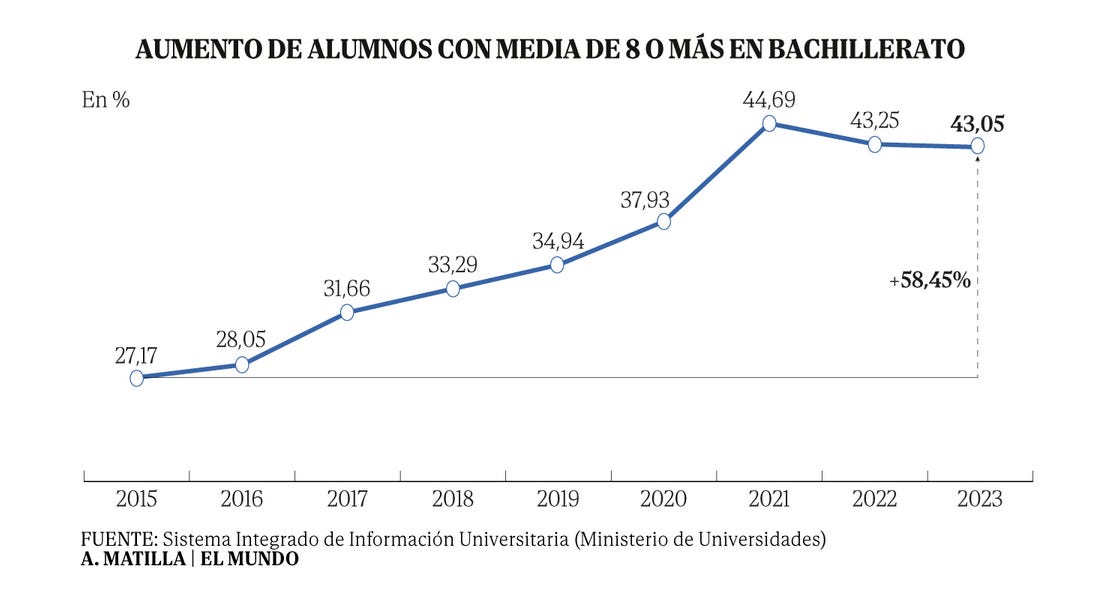
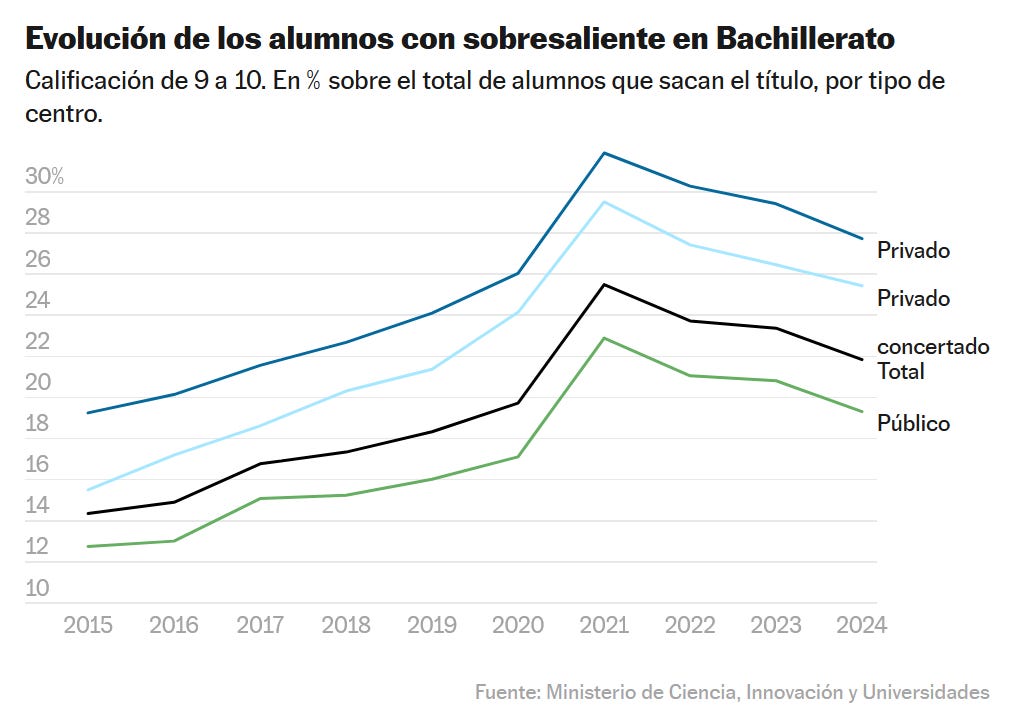
So after all this evidence, let’s take it as established: this is not an Anglo-Saxon problem, not a university problem, and it cuts across every level of education.
There’s nobody to blame: there’s an architecture
If the phenomenon is this widespread and has been running this long, the explanation cannot be anyone’s bad intentions. What we have is a combination of mechanisms that produces the same result in very different contexts.
The first is the teacher’s cognitive bias. Teachers have an internalized image of how many students should pass their course. When the actual level of students falls, the threshold adjusts unconsciously to preserve that image. There is no decision to lower the bar: the bar moves on its own. This study from KU Leuven demonstrates it with precision: grade inflation benefits almost exclusively low-performing students — those on the margin between passing and failing — while high-performing students experience no change at all.
The second is the design of assessment. This study from the Universidad Politècnica de València and the University of Seville shows that the subjects with the most inflation are those that rely on subjective evaluations and imprecise rubrics. When assessment is multiple and independent, inflation drops sharply. Bias needs room to operate.
The third is poorly calibrated reforms. Spain documents this clearly: every change to the EBAU‘s design that reduces the exam’s formal demands has an inflationary effect that gets absorbed into the system and doesn’t disappear, as the EsadeEcPol report shows.
The fourth is institutional pressure on teachers. At universities, student satisfaction surveys are used to evaluate and promote faculty. A strict teacher accumulates poor ratings. Princeton illustrates this perfectly: in 2005, the university implemented a policy capping the proportion of top grades. It worked. In 2014 it was abandoned because, according to the president’s own statement, it had become “a considerable source of stress.” Grades returned immediately to 2002 levels. Nobody decides to inflate. The system’s internal incentives are designed to make it happen on their own.
Who pays the price
If 79% of grades are top marks, a top mark says nothing. The transcript loses precisely the informational capacity that was supposed to justify years of differential effort.
For the students the system claims to be helping: passing because of the assessor’s perverse incentives is not the same as learning more. That student arrives in the labor market with a degree that overstates their real competence, and the signal fails at the moment they need it most.
And when a signal loses reliability, the market looks for others. The most immediate consequence is that the value of a master’s degree as a differentiating credential shoots up — and so does the advantage of those who can afford one. Grade inflation, paradoxically, is most expensive for those who have the least.
We’ll see.
P.S.: In a future post, I’ll explain why top Asian universities don’t have this problem.